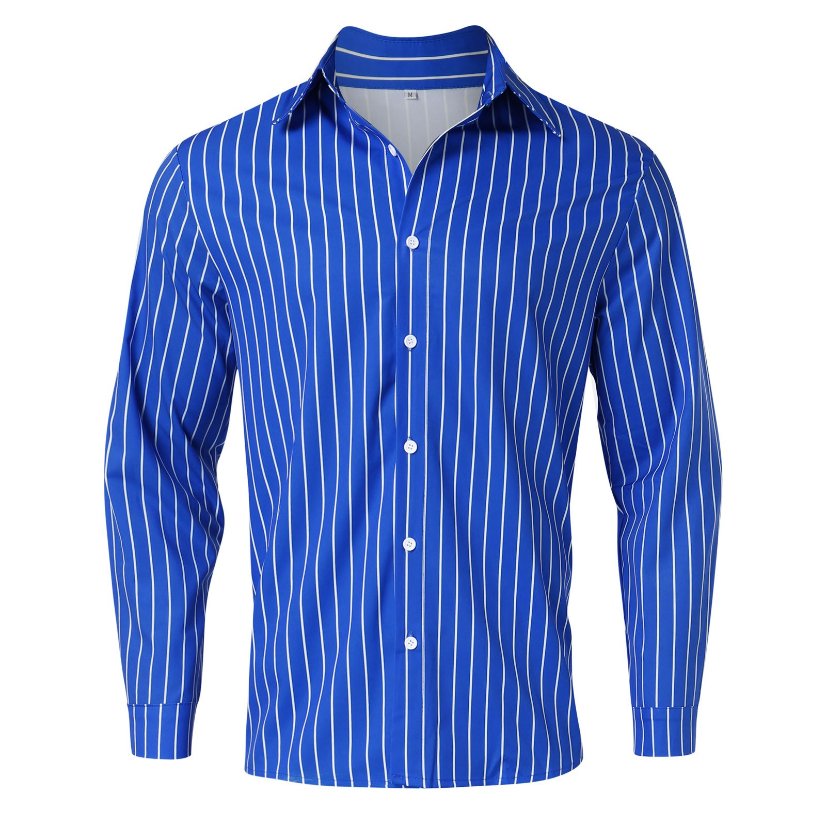
When requesting a shirt sample, ask Juntang Print for collar and cuff views tied to the actual offered version. Identify the outer and inner faces required and keep each image labelled by garment part. The official product card provides a front-view shirt reference, but it does not show every concealed edge, fastening detail or material. Confirm what sample or detail reference the supplier can provide, then use those views to identify the proposal rather than treating them as proof of tested construction quality.
Connect the detail request to one shirt version
Attach the exact men’s shirt reference and identify the blue striped product-card image. Ask the supplier which offered version corresponds to that reference. The front view helps locate the enquiry, while the requested detail views should establish the identity of the collar and cuffs for the actual proposal.
Keep the quotation or sample reference beside the image request. A detail photograph of a different shirt should not silently substitute for the offered version. If the supplier proposes an alternative, ask it to identify that alternative before the buyer uses its collar or cuff appearance as an approval reference.
Name the collar faces the buyer needs to see
Ask for a clear outer collar view and identify any inner view needed for the purchasing question. State the relevant area directly rather than asking only for a closer photo. The supplier should understand whether the buyer wants the collar outline, its relation to the neckline or another specifically identified detail.
Do not infer concealed material or reinforcement from the outline alone. A photograph can help identify a visible proposal without establishing the composition or internal construction of the collar. Request the applicable supplier description separately if those details matter to the order, keeping the visual reference and material statement distinct.
Requested view | Identification question | Keep with the proposal
Whole shirt | Which offered version do these detail images represent? | Garment and quotation reference
Outer collar | Which visible outline belongs to this proposal? | Labelled collar view
Inner collar area | Which concealed or reverse face is relevant to the request? | Clearly identified view and supplier explanation
Outer cuff | Which cuff and fastening presentation are shown? | Named sleeve and cuff reference
Inner cuff area | What reverse-side detail needs clarification? | Corresponding labelled image without assumed construction
Identify cuff views without assigning hidden features
Ask the supplier to identify the cuff shown in each returned image and the presentation used. If the buyer needs both the outer face and a corresponding inner view, state that requirement explicitly. Keep the relevant sleeve reference clear when the two sides of a garment are shown in separate photographs.
Request identification of any fastening detail that belongs to the offer rather than counting or classifying it from an unclear whole-shirt image. Do not assume a concealed feature exists, assign an adjustment range or treat the pictured cuff as a complete dimensional specification. Any required measurements need their own supplier-defined reference.
Separate the shown sample from a proposed alternative
Ask whether the supplier is showing an existing reference, an offered sample or a proposed alternative. Keep that status attached to the returned views. A product-card image does not establish that a physical sample is ready to dispatch, nor does an enquiry establish the availability of a requested collar or cuff change.
If the buyer proposes a different detail, mark the requested change against the identified view and ask the supplier to respond. Retain the distinction between the current reference and the proposed revision until the supplier confirms what it can offer. Do not let an annotated request become an assumed accepted construction.
• Link every detail image to the offered shirt version.
• Name the collar and cuff faces required for the enquiry.
• Keep current references separate from requested alternatives.
• Confirm sample availability and terms directly with the supplier.
Keep visual identification separate from quality claims
A clear photograph can make a collar or cuff easier to identify, but it does not independently verify seam strength, durability, colour retention or care performance. Request any relevant product information or agreed assessment separately for the actual purchasing requirement. Avoid approving an unseen property because the visible finish appears familiar.
The same limit applies to fabric composition and fit. A striped appearance does not provide fibre percentages, and a front-view shirt does not establish how another wearer will experience the garment. Use the returned views for the question they answer: identifying the actual proposed collar and cuff details.
Send a collar-and-cuff view request
An enquiry can read: For the linked men’s shirt reference, please identify the version offered and provide labelled collar and cuff views. Show the relevant outer faces and corresponding inner areas needed to explain the proposal. State whether the images represent an existing reference, an offered sample or an alternative, and confirm sample availability separately.
Keep the supplier’s returned views beside the quotation. Request replacement references if the collar, cuff or garment version changes. This gives the buyer a precise visual-identification record without inventing concealed features, assuming immediate sample supply or presenting photographs as verified material or performance evidence.
Frequently asked questions
Does the front-view product card show every collar detail?
Request the relevant outer and inner views for the actual offered version.
Should two cuff images be assumed to show the same sleeve?
Ask the supplier to identify the cuff and sleeve reference associated with each view.
Does a catalogue image prove a sample is ready to send?
Confirm the supplier’s actual sample proposal and availability separately.
Can detail photographs verify durability or fibre composition?
Keep any required material information and performance assessment separate from visual identification.
Product and contact references
Product reference: https://juntangprint.com/product/men-s-shirt/
Related apparel styles: https://juntangprint.com/products/
Contact Juntang Print: https://juntangprint.com/contact/
Juntang Print blog: https://juntangprint.com/blog/